
A morning and evening routine on the wall changes the family dynamic: the child knows what to do, the parent stops repeating, and everyone starts or ends the day more calmly. This guide gives you age-by-age routines from 5 to 14 and a free printable routine chart, for the morning and the evening. For ages 3 and 4, the principle still holds but works through pictograms rather than check boxes.
The short answer: an effective routine fits in 4 to 8 steps depending on age, always in the same order, posted where the action happens and filled in with the child. The printable chart is a free download below.
Why a routine chart changes mornings
In the morning, a child’s brain isn’t wired to run through six spoken instructions alone. Every “get dressed, we’re late” gets lost between two games. The routine chart externalizes the list: it’s no longer the parent ordering, it’s the chart reminding. The difference is huge.
Three mechanisms explain why visual routines work:
- Predictability reassures. A child who knows what comes next cooperates more easily than one facing unexpected instructions.
- The image replaces the nagging. Pointing at the chart is enough; the parent’s voice stays free for something other than reminders.
- Checking off motivates. Each checked box is a small visible win, and that sense of progress is exactly what installs the habit.
That’s the principle at the heart of Harmonia: visual routines, simple steps, and progress the child can see.
The ideal morning routine, by age
The golden rule: fewer steps than you think. A morning routine should fit in 4 to 8 steps depending on age, or it becomes a chore list.
Ages 5 to 7: 4 to 6 steps, with images
- Use the bathroom and wash hands
- Get dressed (clothes laid out the night before)
- Eat breakfast
- Brush teeth
- Put on shoes and coat
- Grab the school bag
At this age, the child still needs an adult to launch each step. The chart doesn’t replace the parent, it replaces the repetitions.
Ages 8 to 11: full independence on the routine
Same structure, but the child runs the sequence alone. Add preparation: checking the bag against the day’s timetable, remembering a water bottle or snack. The goal for this age is that the parent steps in only once, at departure.
Ages 12 to 14: the routine becomes a contract
A teen won’t obey a chart of pictograms, and that’s normal. The routine is negotiated: wake-up time, bathroom time, leaving on time. Tracking focuses less on the steps than on the result, and this is often where paper shows its limits: an app with points and streaks speaks to this age better than a sheet on the wall.
The evening routine that truly prepares for sleep
In the evening, the point isn’t speed but a gradual wind-down toward sleep. A good evening routine starts about an hour before lights out and always runs in the same order, from most active to calmest:
- Quick room tidy-up (5 minutes, no more)
- Prepare for tomorrow: clothes and school bag
- Bath or shower
- Pajamas, brushing teeth
- Quiet time: reading, a story, a chat
- In bed, lights out
Screens stop before the routine, not during it: screen light delays falling asleep, and negotiating over “five more minutes” ruins the wind-down toward calm.

To set bedtime, lean on the recommendations of the American Academy of Sleep Medicine (AASM consensus, 2016, still the current reference):
| Age | Recommended sleep per 24h | Asleep by (wake-up at 7am) |
|---|---|---|
| 3 to 5 | 10 to 13 hours | 9pm |
| 6 to 12 | 9 to 12 hours | 10pm |
| 13 to 18 | 8 to 10 hours | 11pm |
An 8-year-old waking at 7am should therefore be asleep between 7pm and 10pm depending on their needs.
Download the printable routine chart (free PDF)
We’ve prepared an A4 printable routine chart, with one page for the morning and one for the evening: steps on the left, days of the week to check off, and room to personalize the steps with your child.
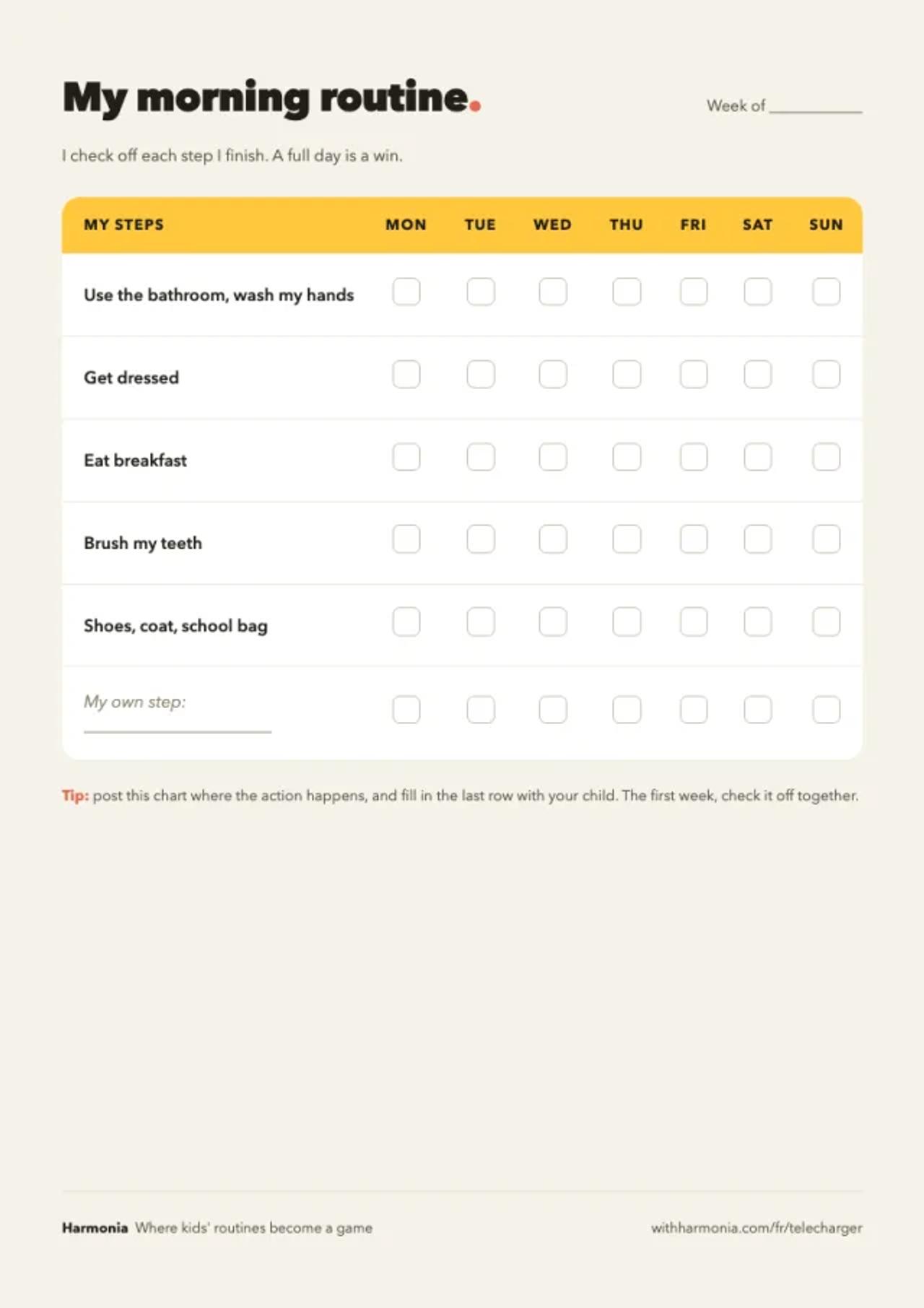
Download the morning and evening routine chart (PDF)
Three tips to make it actually work:
- Post it where the action happens: the bedroom door or the bathroom mirror, not the fridge.
- Fill it in with the child, not for them. An imposed routine is a sabotaged routine.
- Check it off together the first week. That validation ritual installs the habit, not the chart itself.

From paper chart to a routine that lasts
The printable routine chart is the best starting point. Its limit shows up after a few weeks: the boxes are all checked or no one checks them anymore, and the novelty wears off.
That’s exactly the stage Harmonia was built for. The app takes the routine-chart principle and adds what paper can’t:
- morning and evening routines that reset every day, with no reprinting
- points and family-chosen rewards, so motivation holds past week two
- shared tracking between both parents, at home and in shared custody
- streaks that reward consistency, not perfection
Every feature is in the free version, for one parent and one child, with as many routines and rewards as you want and no ads. Download Harmonia on iOS or Android.
And if your child takes to the missions, continue with our chore chart by age to extend the routine to everyday responsibilities.
In short: print the chart, fill it in with your child, check it off together the first week. Lighter mornings and calmer evenings don’t come from a perfect list, but from how consistently you live it together.
Frequently asked questions
At what age should you start a visual routine with a child?
From age 3 with pictograms, and from age 5 with a routine chart to check off. Before reading, images are enough: the child recognizes the steps and gains independence without knowing how to read.
How many steps should a morning routine have?
Between 4 and 6 steps for a 5 to 7 year old, up to 8 for older children. Beyond that, the list discourages instead of helping. A short routine kept every day beats a perfect list abandoned within a week.
What should I do when my child refuses to follow their routine?
Go back to a shorter version, let them choose the order of the steps, and praise each step completed rather than pointing out the ones missed. If refusal persists, it usually means the routine was decided for them, not with them.
A paper chart or an app, which should I choose?
Paper is perfect to start: visible in the kitchen, free, immediate. The app takes over when you want consistency over time: reminders, streak tracking, points and rewards, syncing between both parents.
How long does it take for a routine to become a habit?
Expect several weeks of consistency; the time varies widely by child and routine complexity. Parental consistency matters more than perfection: a step missed one day doesn’t break the habit, giving up completely does.