
A reward chart used well motivates a child without paying them for every move. Used badly, it becomes a negotiating machine where nothing gets done without a payoff. The difference comes down to one thing: reward consistency, not the moment. Here is how to set up a reward chart that works, and a template to print to get started.
The short answer: an effective reward chart values repeated behavior over time, with rewards chosen with the child and most often non-material. Define 1 to 3 clear goals, celebrate progress, and evolve the system when the novelty fades. The printable template is below.
Why positive reinforcement works
The principle behind the reward chart has a name: positive reinforcement. The idea is simple: a behavior followed by a pleasant consequence is more likely to repeat. It’s a documented learning mechanism: the meta-analysis of the Triple P parenting program, covering more than 100 studies (Sanders et al., Clinical Psychology Review, 2014), measured lasting positive effects of encouragement-based approaches, and the American Academy of Pediatrics guidance on positive discipline points the same way.
In practice, the chart makes three things visible:
- The expected behavior, phrased positively (“I brush my teeth” rather than “stop dawdling”).
- The progress, box after box, which a child can’t perceive in abstract time.
- The reward, known in advance, which sets a direction without surprises.

Reward vs bribe: the difference that changes everything
It’s the fear of many parents, and it’s legitimate. The line is clear:
- Bribing reacts in the heat of the moment. “If you stop shouting right now, you’ll get a candy.” You buy the end of a behavior under pressure, and the child learns that the meltdown pays.
- The reward is decided calmly. You agree together, outside of any conflict, that a week of evening routine kept earns a privilege. The child learns that consistency pays.
| Bribe | Reward | |
|---|---|---|
| When it’s decided | In the heat of the moment, mid-meltdown | Calmly, before any conflict |
| What it aims at | Stopping an immediate behavior | Installing a repeated behavior |
| What the child learns | The meltdown pays | Consistency pays |
A well-made reward chart is by nature on the calm side: it’s set in advance, it targets repeated behavior, and it isn’t renegotiated at every meltdown.
Setting up a reward chart in 4 steps
- Choose 1 to 3 behaviors, no more. A chart that targets everything changes nothing. Aim at what really snags: the evening routine, homework, respecting one specific rule.
- Phrase it positively and in the present. “I pack my school bag when I get home” can be checked; “don’t forget your stuff” can’t.
- Define the reward with the child. Favor time and activities (a game together, choosing the meal, an outing) over objects. And set the threshold clearly: how many boxes for which reward.
- Celebrate progress, not just the result. Value each checked box, and never remove an earned box as punishment: it’s the surest way to kill motivation.
Download the printable reward chart (free PDF)
Our A4 reward chart template includes a weekly grid to check off, a space to write the agreed goal and reward, and room to personalize with your child.
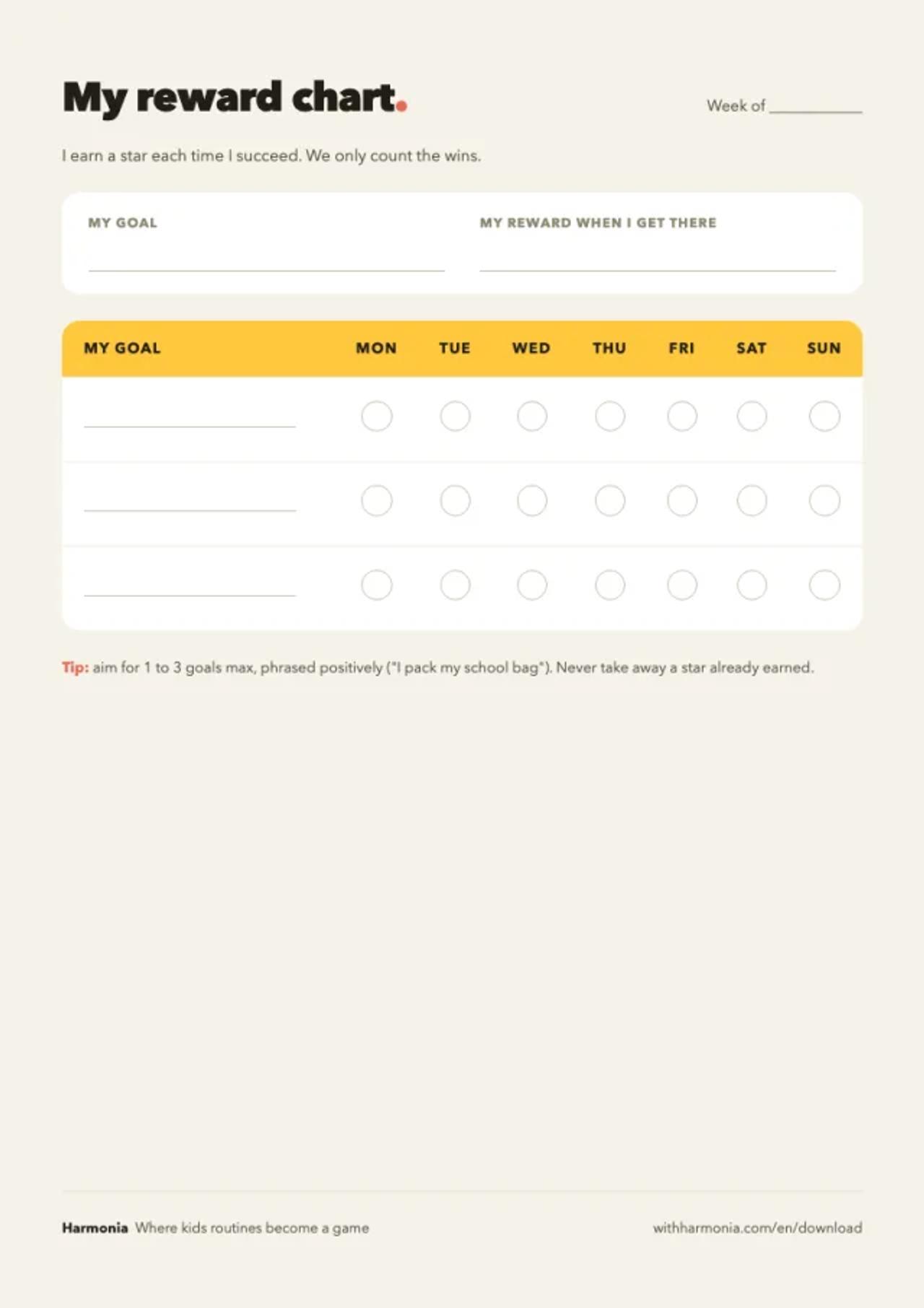
Download the reward chart (PDF)
As with a routine chart, post it at child height and fill it in together.

When the paper chart shows its limits
The paper chart is perfect to test the method. Its weakness comes fast: the novelty wears off, the rewards don’t renew, and with several children the management gets heavy.
That’s exactly what Harmonia automates. The app takes the positive-reinforcement principle and adds what paper can’t: points that accumulate, a family-defined reward catalogue that’s easy to evolve, streaks that value consistency, and tracking shared between parents. Behaviors and rewards reset and renew without reprinting. Every feature sits in the free version, for one parent and one child, download it here.
If your child has a particular profile (ADHD, attention difficulties), read our dedicated article: reward charts and ADHD, adapting without stigmatizing.
Around 10 or 12, symbolic rewards start losing their pull and money takes over as the question. That is the point to read how much allowance by age, which covers the amounts families actually give and how to settle the link with chores before it gets renegotiated every week.
In short: target few behaviors, phrase them positively, choose the rewards with the child and celebrate consistency. The chart gets the dynamic going; self-renewing tracking makes it last.
Frequently asked questions
Is a reward chart just bribing your child?
No, as long as you reward consistent behavior rather than each isolated act. Bribing means negotiating in the heat of the moment to stop a meltdown. A reward chart rewards a steady effort agreed in advance and calmly: it’s not the same mechanism.
At what age does a reward chart work best?
Between 4 and 10, the age where visual, immediate gratification speaks loudest. Before 4, keep it extremely simple; after 10, shift toward negotiated goals and less childlike tracking.
Does there have to be a material reward every time?
No, and it’s actually best avoided. The most effective reward is often chosen time together, a privilege, or an activity. Systematic material rewards raise the stakes and weaken motivation over time.
What do I do when my child loses interest in the chart?
It’s normal after a few weeks: the novelty wears off. Change the rewards, reduce the number of boxes, or move to tracking that renews itself rather than a sheet frozen on the wall.