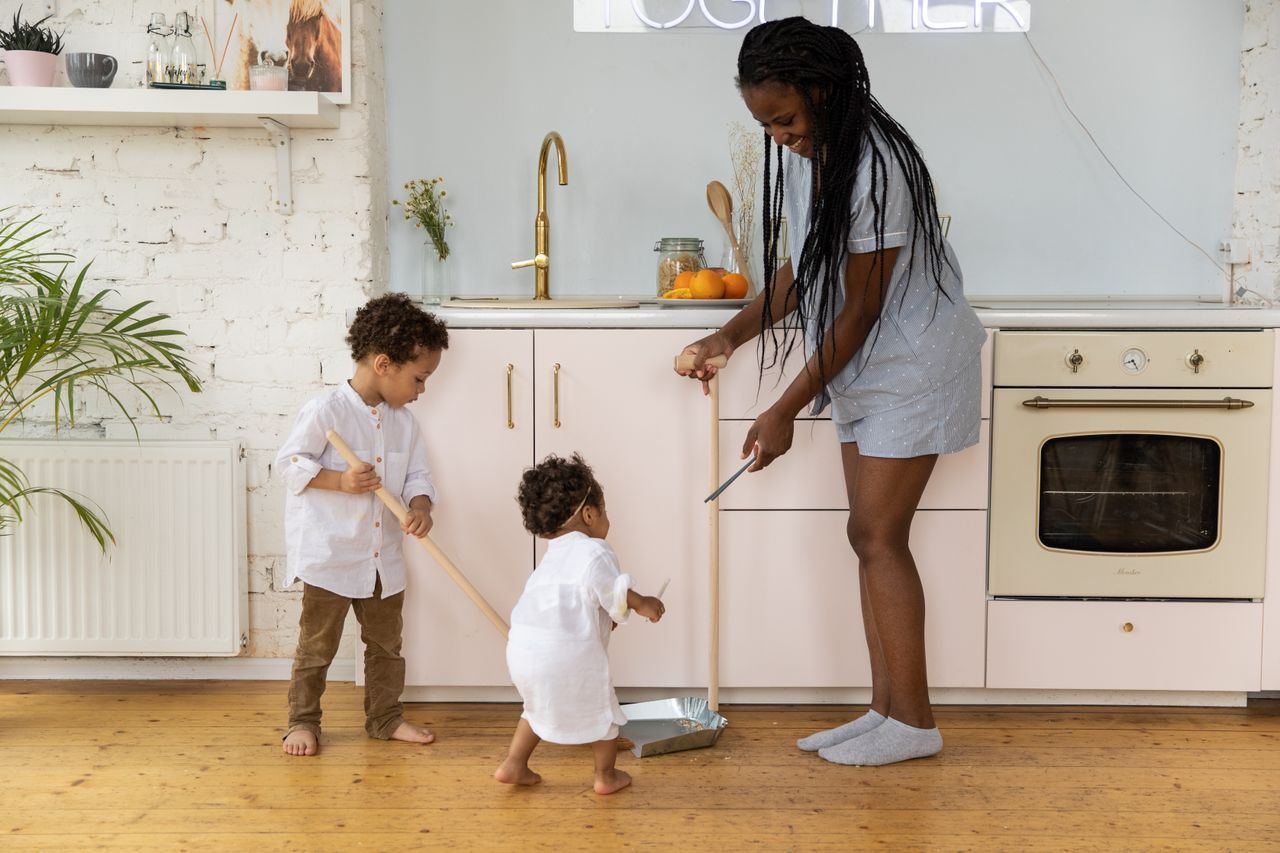
Which chores can you give a 4-year-old, an 8-year-old or a 13-year-old? Here is the chore chart by age, from 3 to 14: what a child can do alone, what they can do with you, and a free generator to build your own printable chart.
The short answer: a child can contribute from age 3 with micro-tasks, gain independence around 6, and handle real responsibilities from 9. The rule: age-appropriate chores, clearly defined, and the same for every child in the home. The printable chart takes a minute to build below.
To build a custom version per child and per day, use our free chore chart generator and print it in a minute.
The chore chart by age
Each age range builds on the previous one. The ages are guides, not standards: a confident 6-year-old can reach into the next column, while a 9-year-old just starting out can begin a column earlier.
| Age | Chores on their own | Chores with help |
|---|---|---|
| 3 to 5 | Put away toys, drop laundry in the basket, water a plant | Set the cutlery, feed the pet, wipe a small surface |
| 6 to 8 | Make their bed, set and clear the table, pack their school bag, fold towels | Empty the dishwasher, wipe down a counter, take out a small bin |
| 9 to 11 | Vacuum their room, hang laundry, take out the bins, make a simple breakfast | Cook from a recipe, clean the bathroom, write a shopping list |
| 12 to 14 | Run a full load of laundry, cook a simple meal, manage their own laundry, clean a whole room | Do local grocery runs, plan the week’s meals |
Three principles for reading this chart:
- Independence doesn’t mean perfection. A bed made by a 6-year-old looks like a bed made by a 6-year-old. If you redo it behind them, they notice, and they stop trying.
- Supervised first, independent later. Every chore is shown two or three times before it moves into the independent column.
- A chore has a visible start and end. “Clean your room” is vague; “put the books back on the shelf” can be finished.

Why give your kids real chores
Pitching in at home builds three things school doesn’t teach: the sense of being useful to your family, the confidence that comes from doing things alone, and the obvious truth that the home is everyone’s job, not one parent’s invisible labor.
Research points the same way: Marty Rossmann’s longitudinal study (University of Minnesota, 2002), which followed children into adulthood, identified taking part in household tasks from age 3 or 4 as one of the best predictors of personal and professional success in early adulthood.
It’s also one of the most direct ways to lighten the parental load: every chore handed off is one you no longer carry, as long as you resist the urge to redo it.
The four mistakes that sink the chore list
- Too many chores at once. Start with a single new chore, let it settle, then add.
- Vague chores. The child should be able to say for themselves whether it’s done.
- Paying for every chore. Normal contribution to the household isn’t a paid service, or tidying a room becomes billable. Save rewards for bonus missions.
- Redoing it behind them. This is the most discouraging message there is. If the result falls short, show again, don’t redo.
Build your printable chore chart (free PDF)
Our generator builds your chart in a minute: add each child, tick the days for each chore, pick a style and download the A4 PDF, ready to put up. Everything happens in your browser, no account and no sign-up.
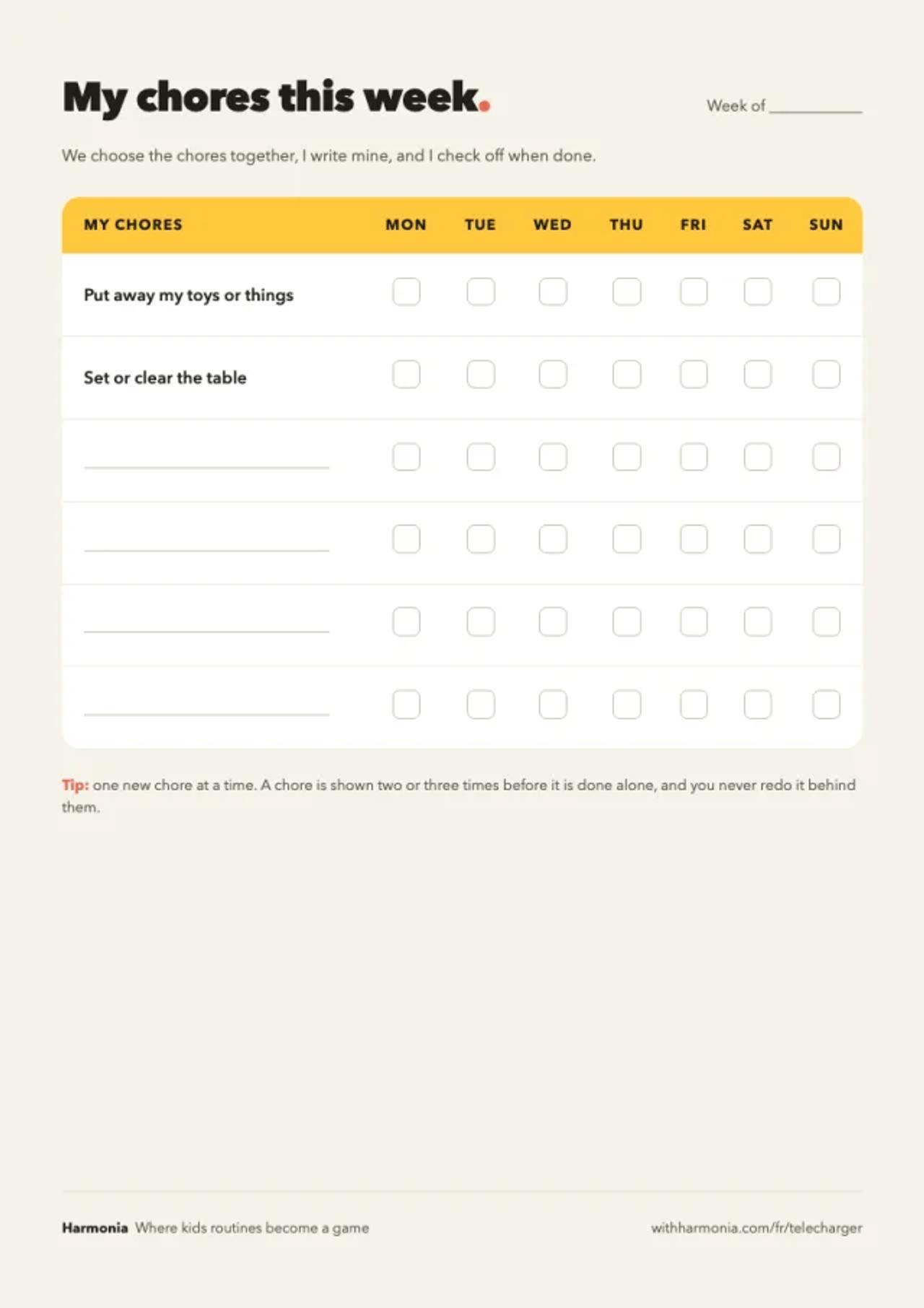
Create my chore chart (free PDF)
Put it up where the chores happen, choose the chores with your child, and check the first week off together.

From paper chart to a system that lasts
The paper chart gets things moving. Its limit shows up fast with several children, two parents taking turns, or shared custody: who did what, what’s been validated, where each child stands.
Harmonia turns that chart into missions: each child has their own age-appropriate list, validates what they’ve done, earns points and picks rewards from a family-defined catalogue. Parents see the whole picture without hovering, and recurring chores reset on their own. Every feature is in the free version, for one parent and one child, with no ads. Discover Harmonia.
To start gently with the youngest, see our chores for 5 to 7 year olds. And once the chores are in place and the pay question comes up, our guide to how much allowance by age covers the amounts families actually give and the decisions that keep the payments going past the first month.
In short: pick one or two chores from your child’s age column, define them clearly, show them, then let them do it without redoing it. The printable chart structures the start; consistency does the rest.
Frequently asked questions
At what age can a child start doing chores?
As early as 2 or 3, with short, supervised micro-tasks: putting away a toy, dropping laundry in the basket. At this age the goal isn’t real help, it’s the habit of contributing.
How many chores per week by age?
One or two short daily chores before age 6, two or three between 6 and 11, then three to five regular responsibilities for a teen. Consistency matters more than quantity: one chore done every day beats five abandoned by the weekend.
Should you pay kids for chores?
Opinions differ. A clear line: don’t pay for the normal contribution to the household (setting the table, tidying their room), and reserve any pay for bonus missions beyond that baseline. The child learns that everyone pitches in, and that extra effort can be rewarded.
What should I do when my child refuses a chore?
First check the chore is age-appropriate and clearly defined, then reduce pressure rather than add to it: a shorter task, a choice between two, a fixed slot in the routine. Lasting refusal usually means the list was imposed rather than built together.
Should chores be the same for boys and girls?
Yes. Rotating chores across all the children, with no distinction, is the simplest and fairest rule, and the best way to avoid the household imbalances of adulthood taking root in childhood.