What does taking more responsibility mean from age 13?
Teenagers are often ready to contribute in ways that go beyond putting away their own belongings. They can begin to look after personal spaces, take regular responsibility for shared areas and notice when a household task needs attention. The aim is to build a gradual path towards independence while keeping expectations compatible with safety, schoolwork, health and the family’s daily rhythm.
It helps to separate three areas. Personal responsibilities include keeping a bedroom reasonably tidy, putting dirty clothes in the right place and managing belongings needed for school or activities. Shared contributions include unloading the dishwasher, taking out household rubbish, setting the table or cleaning a bathroom. Occasional responsibilities might include helping prepare a room before guests arrive, sorting items for donation or assisting with a larger household task.
Independence develops in stages. A teenager may first learn how to do a task with an adult nearby. The next step is remembering to do it without repeated prompts. Later, the teenager can organise the materials, choose a suitable time and check the result. These stages matter because knowing how to complete a task is different from noticing that it needs to be done.
Age provides a useful starting point, but it does not decide everything. Consider concentration, physical ability, confidence, household equipment, safety and the teenager’s current commitments. A responsibility that works well for one 13-year-old may need a different level of support for another. The chore chart by age can help situate this stage within a broader progression, without turning age into a rigid timetable.
Categories of chores that suit teenagers
A useful list combines predictable tasks with responsibilities that encourage planning. Start with chores whose result is easy to see. This makes the expectation clearer and gives the teenager a practical way to check whether the task is complete.
Examples of regular and occasional chores for teenagers aged 13 and up.
| Category | Possible chores |
|---|---|
| Personal | Tidy bedroom, manage laundry, prepare school items |
| Daily shared | Load or unload dishwasher, set the table, clear dishes |
| Weekly shared | Vacuum a room, clean a bathroom, change bed linen |
| Household routine | Take out rubbish, sort recycling, check supplies |
| Planning-based | Prepare a simple meal, organise a laundry cycle, plan ingredients |
| Occasional | Prepare a room for guests, help with shopping, sort donations |
Some tasks need a defined adult framework. Using an oven, strong cleaning products, sharp tools, electrical equipment or heavy appliances may be appropriate in one home and unsuitable in another. Explain the safety limits before assigning the task: which equipment may be used, what must remain off limits and when an adult needs to be present or check the result.
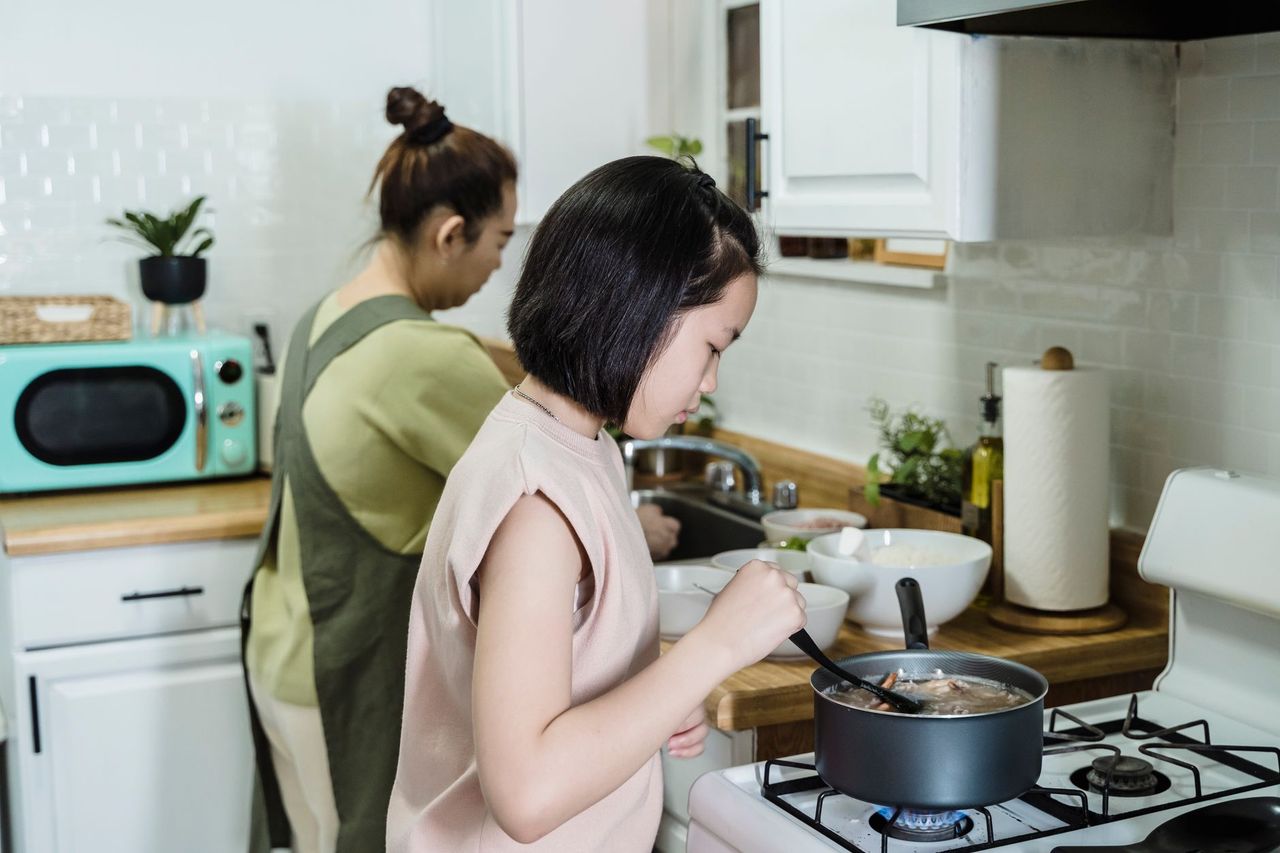
Planning-based chores are especially valuable once basic routines are established. Preparing a simple meal involves checking what is available, starting at a sensible time, following instructions and leaving the kitchen ready for the next person. Managing laundry involves sorting appropriately, choosing a cycle that has already been approved and putting items away afterwards. Introduce these responsibilities one part at a time rather than handing them over as an unexplained household duty.
How to build a gradual plan from age 13 onwards
Begin with a small, clearly bounded arrangement. One personal task and one shared task are enough to test whether the timing, instructions and level of support are realistic. For example, the teenager might keep their room floor clear and unload the dishwasher after dinner on agreed days. The adult should explain what finished means, then allow the teenager to complete the task without narrating every step.
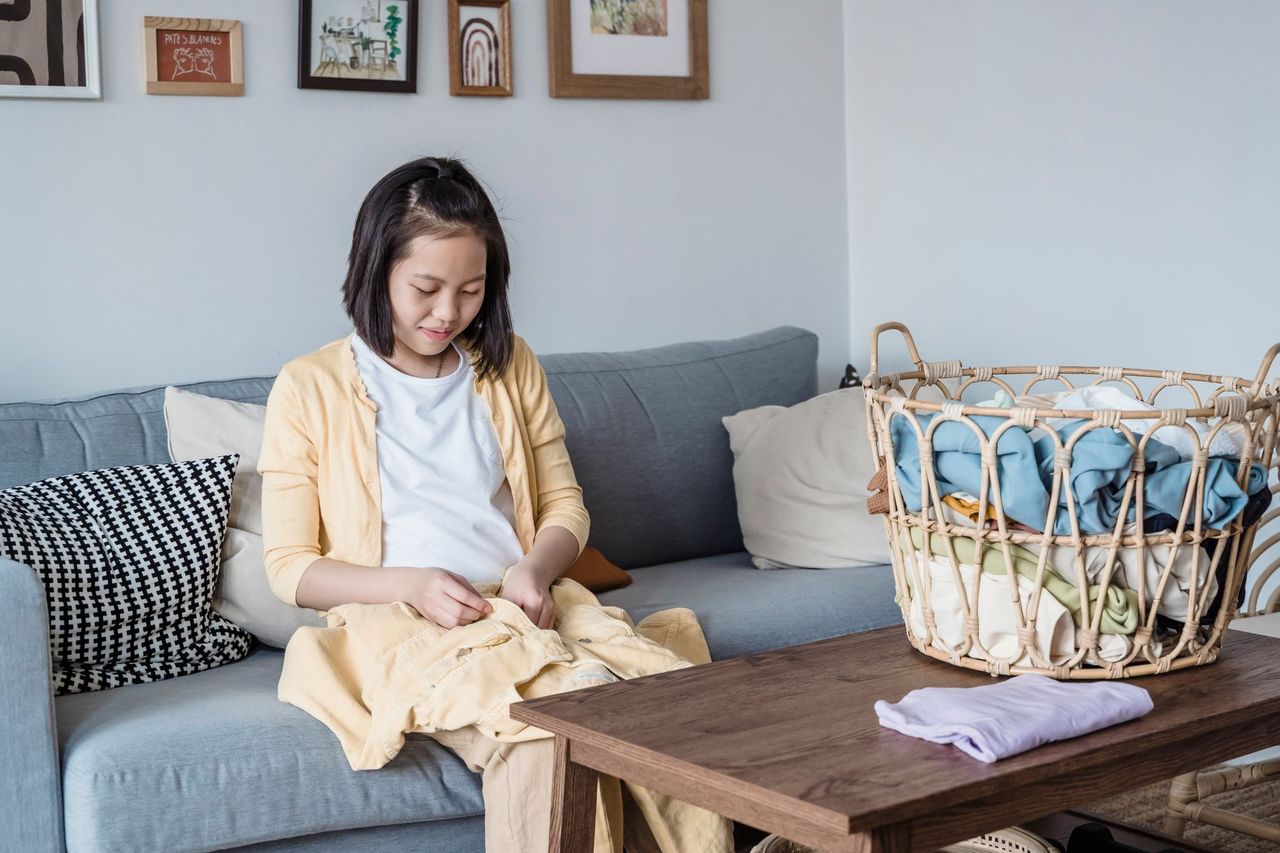
The next stage is ownership from beginning to end. Instead of asking a teenager to fold laundry that someone else has washed, the responsibility might include collecting the clean clothes, folding them, putting them away and checking that the basket is ready for the next load. A complete responsibility has a clear beginning and end, so there is less room for confusion about who is expected to do what.
A progression from supported chores to responsibilities managed more independently.
| Stage | Teenager’s role | Adult’s role |
|---|---|---|
| Learn | Follow the steps with guidance | Demonstrate and define safety limits |
| Practise | Complete the task with a reminder | Review the result and correct one point |
| Manage | Remember the task and gather materials | Remain available if a problem arises |
| Organise | Plan timing, complete and check the task | Review the arrangement periodically |
Once regular responsibilities are reliable, introduce occasional tasks. A teenager might prepare the dining area before visitors arrive, help make a shopping list or organise a cupboard. These tasks require judgement because the teenager must interpret the situation rather than repeat the same action every day. Give the first few assignments a clear purpose and a reasonable deadline.
The responsibility chart can be useful when the family needs to clarify who owns each task and what belongs in each box. The chart should support the conversation, not become a long list that nobody can maintain.
Write instructions that leave room for independence
A vague instruction creates repeated reminders. “Keep the kitchen clean” can mean several different things, while “After dinner on Monday and Wednesday, load the dishwasher, wipe the table and leave the sink clear” gives a teenager a workable starting point.
- State the finished result: what should be clean, put away, checked or ready?
- Name the frequency and the time window, rather than relying on constant prompts.
- Identify the approved materials and equipment.
- Explain the limits: what the teenager should not handle alone.
- Say when an adult will step in, especially for safety or a final check.
Avoid turning the instruction into a script that must be repeated every time. The goal is to make the result and boundaries clear enough for the teenager to choose the practical steps. If the task is often incomplete, first check the instruction, timing and equipment before assuming that the teenager is refusing responsibility.
A short weekly review can replace many daily negotiations. Ask what worked, where the task became difficult and whether the timing still fits the week. The review should lead to one concrete adjustment: change the day, reduce the scope, add a checklist or introduce the next step. Completing the task for the teenager may solve the immediate problem, but it does not clarify what should happen next time.
Distribute chores without creating an impossible list
A teenager’s chore plan should fit around school, sleep, activities, health and the responsibilities of other household members. Fixed chores are the tasks expected every week. Variable chores can be assigned when time and circumstances allow. Keeping these categories separate prevents an occasional request from quietly becoming another permanent obligation.
Start with a limited number of fixed responsibilities and observe the plan for several days. Look at completion, timing and effort rather than demanding a perfect household. If a task regularly clashes with homework or an activity, change the schedule. A visible weekly plan can help the whole family see when chores happen and avoid relying on whoever happens to notice first. The weekly chore schedule offers a framework for distributing tasks and reviewing whether the arrangement lasts.
- List the teenager’s fixed personal responsibility.
- Add one or two shared tasks with clear days or time windows.
- Mark occasional tasks separately from weekly commitments.
- Leave room for changes during busy school or activity weeks.
- Review the plan after a few days, then make one adjustment if needed.
Review responsibilities and separate them from allowance
As a teenager becomes more capable, the list should change. A mastered task may stay as a contribution, become part of a larger responsibility or be replaced by a new challenge. Increasing frequency is not always the best next step. Adding planning, preparation or a final check may develop more independence without creating a heavier schedule.
Keep ordinary contributions to family life separate from tasks that may be linked to allowance. Everyone who lives in a home can be expected to take part in reasonable shared responsibilities. Optional paid tasks can be discussed separately, with a clear description of the work and when payment applies. This distinction prevents every request for help from becoming a negotiation about money.
Allowance also involves spending rules, timing, saving and what happens when money runs out. Those questions deserve their own conversation. For a dedicated framework, see Teen Allowance: What It Covers, and What to Do When It Runs Out.
Key takeaways for tonight
- Choose one personal chore and one shared chore with an observable result.
- Write the frequency, expected result, equipment and safety limits before asking for independence.
- Move from completing a step to managing the whole task, including preparation and checking.
- Separate fixed weekly responsibilities from occasional requests and optional paid tasks.
- Hold a short weekly review and adjust the plan according to real mastery, schedule and safety.
Frequently asked questions
What are appropriate chores for teenagers aged 13 and up?
Appropriate chores include caring for a bedroom, managing personal laundry, loading or unloading the dishwasher, taking out rubbish, cleaning a bathroom, vacuuming, preparing a simple meal and checking household supplies. Tasks involving heat, chemicals, sharp tools or heavy equipment need clear safety limits and may require adult supervision.
How many chores should a 13-year-old or older teenager have?
There is no universal number. Start with one personal responsibility and one shared household task, then add responsibilities only when the timing, instructions and result are manageable. School demands, activities, health, ability and the contributions expected from other family members should guide the final list.
How can parents make chores for teenagers more independent?
Define the finished result, frequency, time window, materials and safety limits. Then let the teenager choose the practical steps instead of giving repeated prompts. Independence can grow from learning the task, to remembering it, to organising and checking it from start to finish.
Which chores can a 13-year-old manage alone?
Many 13-year-olds can manage personal tidying, putting away belongings, changing bed linen, sorting or folding approved laundry, unloading a dishwasher, taking out rubbish and cleaning simple areas. Whether a task can be done alone depends on the equipment, the home’s safety rules and the teenager’s demonstrated ability.
Should teenagers be paid for every household chore?
Payment for every chore is not required. It can be clearer to treat reasonable personal and shared responsibilities as part of living together, then discuss optional paid tasks separately. If allowance is involved, define which tasks are included, what counts as complete and how payment is handled.
How should the chore list change as a teenager becomes more independent?
Use demonstrated mastery as the guide. You can remove constant reminders, transfer the full task from preparation to final check, add an occasional planning responsibility or change the frequency. Review the arrangement weekly at first, then less often once it works reliably.