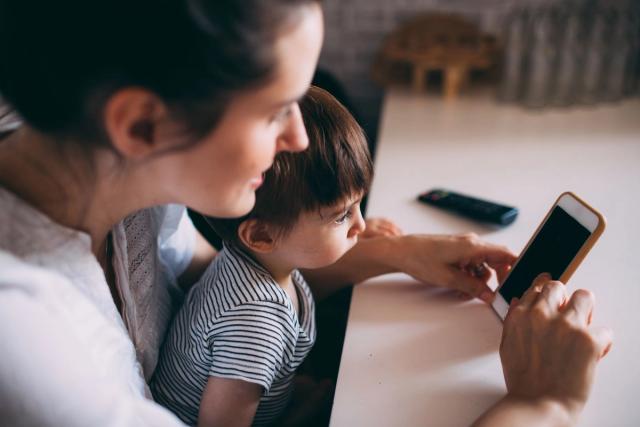
There is no single answer to screen time by age. The World Health Organization caps it at one hour a day up to age four, the Mayo Clinic stops giving an hourly figure after age five, and surveys that measure what children actually do land well above both. The rules every source does share are about timing: no screens in the morning before school, none at meals, none in the bedroom, and none before bed.
For the same age, you will find figures that are far apart, and the gap comes mostly from what each number is measuring.
The short version: there is no correct duration, and you will lose an evening looking for it. Pick one of the four cut-offs instead, the one that is already half respected in your home, and hold it a week before adding a second.
Where those numbers come from
You probably ran this search on a Sunday evening, after asking for the tablet back for the third time. One page says one hour for a six-year-old, the next says two, and a third explains that counting hours is the wrong approach altogether. And you close the tab without knowing whether your own rule is too loose or too strict.
The numbers disagree because they are not all answering the same question. Two kinds of figures circulate, and nothing on the page tells you which one you are reading.
The first kind is a recommendation. The World Health Organization, in its April 2019 guidelines, advises no screen time before age one, then caps it at one hour a day for two-, three- and four-year-olds, adding that less is better. Mayo Clinic lands in the same place for ages two to five, one hour a day of high-quality programming, and adds that past age five "a one-size-fits-all approach doesn't work as well."
The second kind is a measured average. When the American Academy of Pediatrics reports that children aged two to four average 2 hours and 8 minutes of media use a day, and 5- to 8-year-olds 3 hours and 38 minutes, it is describing what a 2025 survey found. The American Academy of Child and Adolescent Psychiatry puts the average for 8- to 18-year-olds at seven and a half hours a day.
An observed average generally runs above the guideline it matches, which is what you would expect, and that gap accounts for most of the apparent contradiction.
Then there is a third case, harder to reconcile: two pediatric bodies giving different advice for the same age. Mayo Clinic says one hour a day for ages two to five. AACAP suggests roughly one hour on weekdays and up to three hours on weekend days for that same bracket, for non-educational content. Both are current, and they simply drew the line in different places.
So when you come across a figure, check who published it and when before measuring your own rule against it.
What each source actually says
| Source | Type of figure | What it states |
|---|---|---|
| WHO, April 2019 | Recommendation, ages 0 to 4 | No screens before age 1, one hour maximum at ages 2, 3 and 4 |
| Mayo Clinic, June 2024 | Recommendation, ages 2 to 5 | One hour a day. Past age 5, no single hourly limit |
| AACAP | Recommendation, ages 2 to 5 | About one hour on weekdays, up to three on weekend days, non-educational content |
| American Academy of Pediatrics | Observed average, 2025 survey | 2 hours 8 minutes a day at ages 2 to 4, 3 hours 38 minutes at ages 5 to 8 |
| AACAP | Observed average | Seven and a half hours a day for ages 8 to 18 |
| CDC, October 2024 | Observed average, teens 12 to 17 | 50.4% of teenagers had four hours or more of daily screen time |
The bottom three rows do not read like the top three. They measure what families do, while the first three state what health bodies advise.
The rules every source agrees on

The durations vary from one source to the next. The times of day come back in almost identical terms. Mayo Clinic, AACAP and the French Ministry of Education each publish a version of the same short list.
- No screens during meals. AACAP puts it plainly: turn off all screens during family meals and outings.
- No screens in the bedroom. Mayo Clinic suggests charging devices outside the bedroom overnight, which takes the decision away from the child.
- No screens before bed. AACAP says 30 to 60 minutes before bedtime, Mayo Clinic says an hour.
- No screens in the morning before school, so the first hours of class are not spent recovering attention.
None of these four asks you to count anything, which is why they survive a Tuesday evening: there is no timer to watch and no app to configure. You decide on a place and a time, once.
Which one to start with
Announce all four in a single evening and you will negotiate all four. Take one, and give it a week.
- Pick the one that is already half in place. If nobody brings a phone to the dinner table, the mealtime rule costs you almost nothing to make explicit, so that is the one to state out loud first.
- Say it at a calm moment, not while the tablet is being handed back under protest. A rule introduced during a conflict is heard as a punishment, and it gets reopened the next day.
- Name the spot where the device goes. A rule that points to a place, the hall shelf or a specific kitchen counter, holds better than a rule that describes a prohibition, because your child knows what to do with the object in their hands.
- Hold it a week before adding a second. If it collapses two evenings running, it was the wrong one to start with, so go back to the first step and choose another.
Expect to repeat yourself. You will not settle screen rules once and for all on a Sunday at seven, and the first evening you give in does not undo the week.
If your child already has a visible evening routine, attach the cut-off to it rather than making it a separate instruction: bath, pyjamas, phone on the shelf. Our morning and evening routine guide covers how to build one.
What these rules do not solve
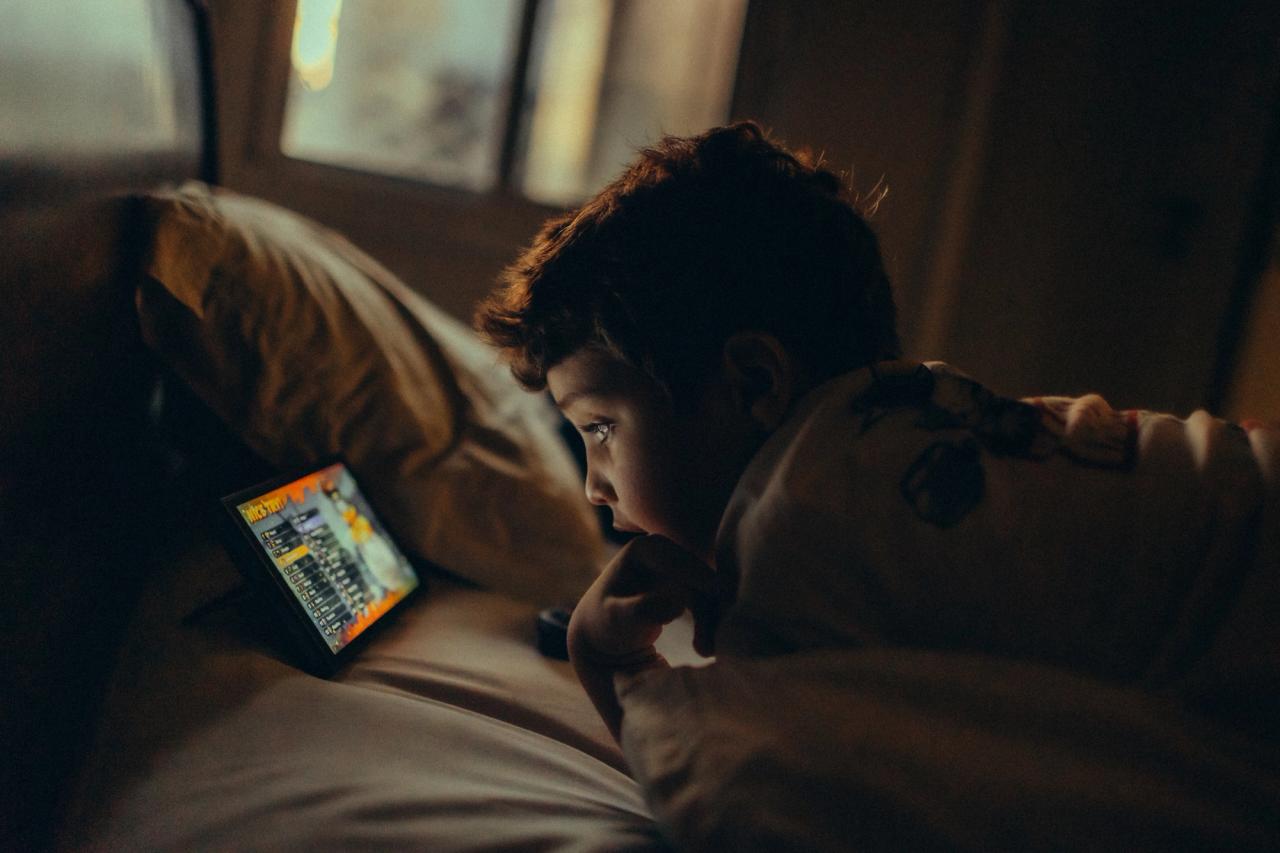
They say nothing about content. An hour on a game your child then describes to you over dinner and an hour of autoplaying videos fill the same box on a counter, and you already know those are not the same evening.
They do not settle homework either. If schoolwork happens on a screen, applying the evening cut-off literally means stopping your child mid-exercise. The simplest approach is to keep schoolwork out of the count and reserve the rule for leisure time. None of the sources above makes that call for you, and if homework is already a flashpoint at home, that subject has its own article.
With a teenager, a rule imposed without discussion rarely holds. The CDC found that just over half of 12- to 17-year-olds spend four hours or more a day on screens, so a household rule written for a seven-year-old will not transfer intact to a fourteen-year-old. The habit that does transfer is writing the rules down where everyone can see them, the same way you might already handle chores and household responsibilities.
Finally, if screens have become the only way to settle your child, or if you notice a clear decline in sleep or mood, this moves beyond a household rule. Talk to your pediatrician.
Key takeaways
- No authority agrees on a duration. The WHO caps it at one hour up to age four, and Mayo Clinic and AACAP give different figures for the same two-to-five bracket. If you are looking for the correct number, there isn't one.
- Check whether the figure you are reading is advice or a measurement. "2 hours 8 minutes for ages 2 to 4" describes what families do, not what is advised, and a measured average generally runs higher than the recommendation it matches.
- The rules shared by every source point to a moment in the day: no screens in the morning before school, none at meals, none in the bedroom, none before bed.
- Put one in place at a time and give it a week. Start with the rule that is already half respected in your home, and name the spot where the device goes at night.
- Keep schoolwork out of the count. Otherwise you will spend your evenings granting exceptions, and the rule will lose its meaning within days.
An evening cut-off holds better when it is part of a routine your child can see coming. Screen time tracking is in the free version of Harmonia, alongside the routines themselves.
Frequently asked questions
What is a healthy amount of screen time for a child?
No two sources give the same figure. The WHO caps it at one hour a day up to age four, Mayo Clinic stops giving an hourly limit after age five, and AACAP suggests about an hour on weekdays and up to three on weekend days for ages two to five. Set your own limit around your evenings, and apply the four timing rules first.
How much screen time is too much?
There is no threshold that applies to every child, and observed averages run well above the published recommendations. Watch what changes around the screens instead: how long bedtime takes, mood in the morning, whether your child still asks to do other things. A clear and lasting decline in any of those is worth raising with your doctor.
Does homework done on a screen count?
The sources above do not settle this. In practice, the workable approach is to keep schoolwork out of the count and reserve your rules for leisure time. If you count homework, you will spend your evenings granting exceptions and your child will end up arguing with the rule itself.
How long before bed should screens go off?
AACAP recommends turning screens off and removing them from bedrooms 30 to 60 minutes before bedtime, and Mayo Clinic suggests an hour, along with charging devices outside the bedroom overnight. Attaching the cut-off to a step your child already knows, bath or pyjamas, works better than a fixed clock time you have to enforce each evening.
How do I limit screen time without an app?
The four rules work without software, because they cover moments and places rather than content. Decide where the device goes at night and what time it stops, then say both out loud once at a calm moment. Parental controls remain useful for filtering what your child can reach, which these rules do not address, so set the rules first and add the tool afterwards if you need it.
My teenager is well over these numbers. Where do I start?
Start with the bedroom and the hour before sleep, which are the two rules with the clearest reasoning behind them and the easiest to explain. Beyond twelve, a rule you have agreed on together holds far longer than one you have imposed, so expect the conversation to take more than one evening.
Does Harmonia track screen time?
Yes, and it is included in the free version. It reports the time spent without applying the four cut-offs for you, since those stay household rules you set yourself. Use the tracking to see where the week landed rather than to arbitrate each evening.