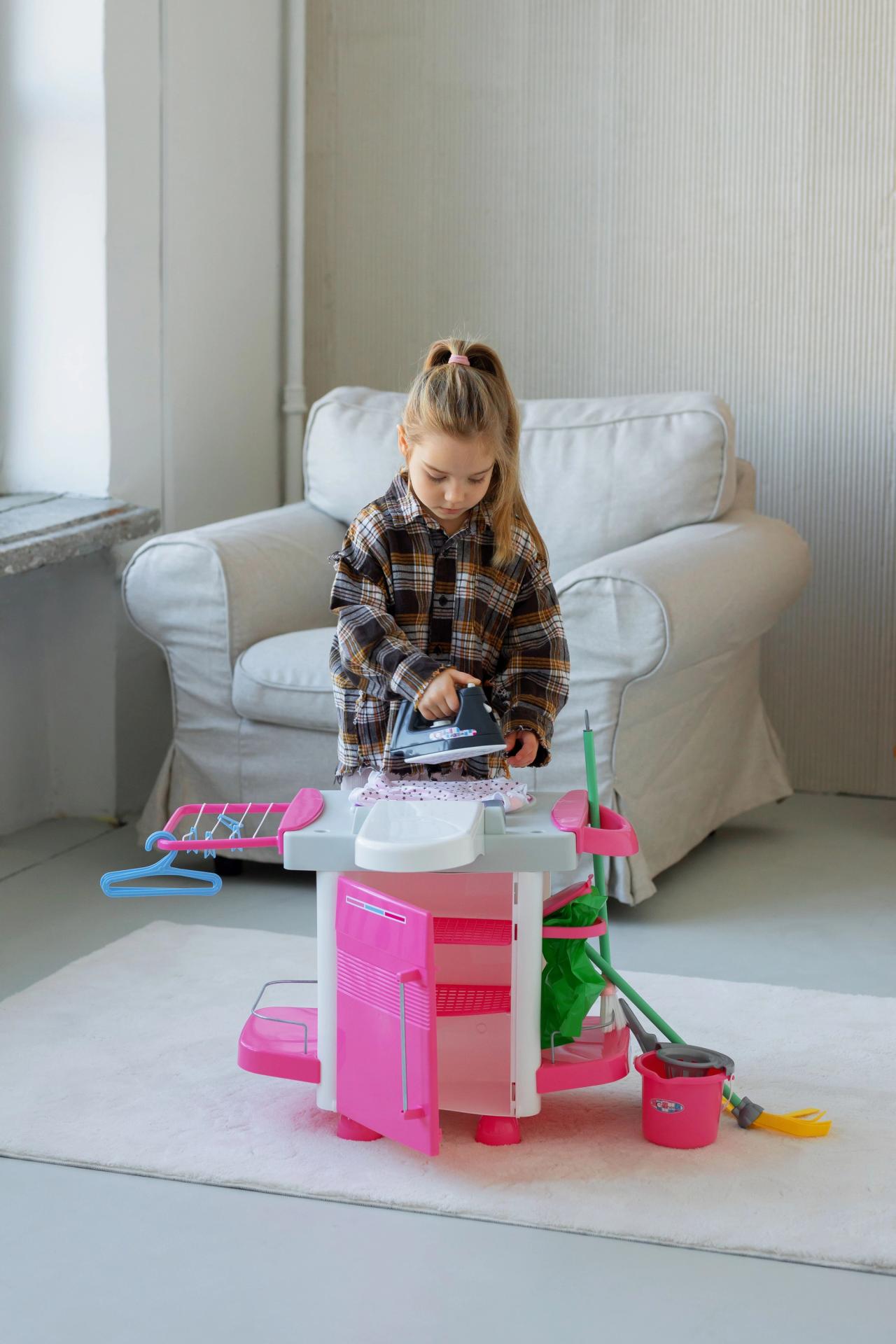
Give one chore at a time, and choose it by what a botched job costs you: sorting socks costs nothing, a full glass costs a glass. Do it next to your child rather than sending him off with it. The reward chart starts earning its place around five or six.
Choose the chore by what a botched job costs
Every list sorts chores by age, and that holds until you are standing in your own kitchen. Your two year old is not the size of the one in the list, your bin is somewhere else, and you either own a dog or you do not. The question that settles it faster is a different one: if this gets done badly, what does it cost you?
Three groups, and the first one is enough to start with.
- A botched job costs nothing: sorting socks, dropping toys into a bin, dusting a low shelf with a damp cloth, watering a plant from a small can, carrying an unbreakable plate to the sink, wiping a table with a cloth wet with plain water.
- A botched job costs something: setting the table with real glasses, carrying a full cup, folding laundry you will refold, feeding the dog, where too much and too little are both wrong.
- Not yet, whatever a list says: anything involving a cleaning product, anything that needs a step stool to reach the worktop, and the pet's water bowl.
Stay in the first group for a good while. The second one is worth trying when you are standing right there and you have time to lose. At half past six on a school night, stick with the first.
It takes longer, and it keeps taking longer
A two year old carrying his plate to the sink takes about ten times as long as you would, and he will still be slower in six months. None of that means the chore was badly chosen. It is the price of the thing, and you pay it for months, which is why the useful decision is about timing: put the chore in a slot where you have ten minutes in hand, rather than in the one where you are already late.
Then there is the question the lists skip, which is what to do when the job is visibly bad. Redo it, but later and out of sight. Redoing it in front of your child cancels what he just finished, and he understands that long before he can say it. Wait until he has moved on.
In the same vein, avoid correcting while he works. One instruction, then you go quiet. Telling a three year old to hold the cloth flatter, then to go the other way, then to press harder, turns two minutes of cleaning into an argument.
What a 2, 3 and 4 year old can take on
Read this as a starting point. A child who has never been asked for anything will begin in the left hand column whatever his age.
| Age | On his own, after you have shown him | Alongside you | What a botched job costs |
|---|---|---|---|
| 2 | Puts toys in a bin; carries his unbreakable plate to the sink | Wipes the table; puts dirty clothes in the basket | Nothing |
| 3 | Waters a plant; sorts socks; lines shoes up by the door | Loads the washing machine; dries unbreakable dishes | A puddle, at worst |
| 4 | Makes his bed his own way; sets the table with unbreakable dishes; feeds the pet from a pre-measured cup | Pours from a small jug; sorts the recycling | A crooked bed, a spill on the table |
Why the reward chart can wait
Charts, stickers and coins work with children who can hold a promise in their head for several days. At two or three that is not yet the case, so the sticker turns into a small object he wants, and the chore turns into the price he pays to get it.
One experiment is worth knowing about, because it points the same way. Felix Warneken and Michael Tomasello gave 36 children of about twenty months the chance to help an adult who had just dropped something. One group got a toy cube each time, one group was thanked, one group got no reaction at all. Once the rewards stopped, the children who had been given cubes helped in 53% of the later trials, against 81% for those who had been thanked and 89% for those who had received nothing.
It is one study, on 36 children younger than yours, and it does not prove that a chart at four will spoil anything. What it does is remind you that motivation is not what you are short of at this age: a two year old wants the broom. Paying for something he already wants to do has little to gain.
What replaces the sticker fits in one sentence: say exactly what he did. "You put every sock in the drawer" teaches a three year old something, where "well done" gives him nothing he can repeat. Around five or six, once a week starts to mean something to him, the chart becomes useful, and that is the moment to look at the chore list by age and to pick up the reward chart method.
What this does not fix
- It is not help. For a year or two, chores done by your child will cost you more time than they save, so if what you want is a lighter week, it will not come from here.
- It does not spread on its own. A child who sweeps happily will not tidy his room because of it, and you will do the same work again chore by chore.
- It can stop. A two year old who fights you for the cloth may refuse flat at three. Ask again a few weeks later, without making it a subject.
What to remember
- One chore at a time at this age. The second one comes when the first happens without being asked, which often takes months.
- Choose by what a botched job costs, not by age. Sorting socks costs nothing; a full glass costs a glass.
- Redo the job later and out of sight. Redoing it in front of your child cancels what he just did.
- Put the chore in a slot where you have ten minutes in hand. A two year old cannot go faster, and a school morning is the worst place to find that out.
- Charts and rewards start earning their place around five or six. Before that, saying exactly what your child did does more than a sticker.
If you are reading this because an older brother or sister already has a chart, the next step is over with the chores for 5 to 7 year olds, and the chore chart generator prints one for the eldest. Harmonia is built for five to fourteen, and it will still be there when your youngest gets there.
Frequently asked questions
At what age can a child start doing chores?
Around two, many children reach for the cloth or the broom before anyone asks. Start there, with a chore where a bad job costs nothing, done next to you. There is no lost time to make up either: a four year old who has never been asked starts in exactly the same place.
How many chores should a three year old have?
One. Add a second when the first one happens without you asking, which often takes months. A five line list on the fridge will not survive this age, and it puts you in the position of chasing five things a day.
Should I reward or pay a toddler for chores?
Not at this age. A two or three year old cannot hold a promise for several days, and in one experiment with twenty month olds, children rewarded with an object went on to help less often than children who were simply thanked. Say precisely what your child just did instead.
My toddler does the chore badly. Should I redo it in front of him?
Redo it later, once he has moved on to something else. Redoing it in front of him cancels what he just finished. And if the result bothers you every single day, the chore is asking too much for his age: swap it for one where a bad job does not show.
He loved helping and now he refuses
Common between two and four, and you did not cause it. Drop the chore for a few weeks, then offer it again without making it a subject. Pushing at this age turns a game into an obligation, and you lose on both counts.
Is it safe to let a toddler clean?
As long as there is no cleaning product and no step stool, yes. A cloth wet with plain water does the same visible job for a three year old. Keep products high up and closed: a child who copies your cleaning will go for the spray he has watched you use.