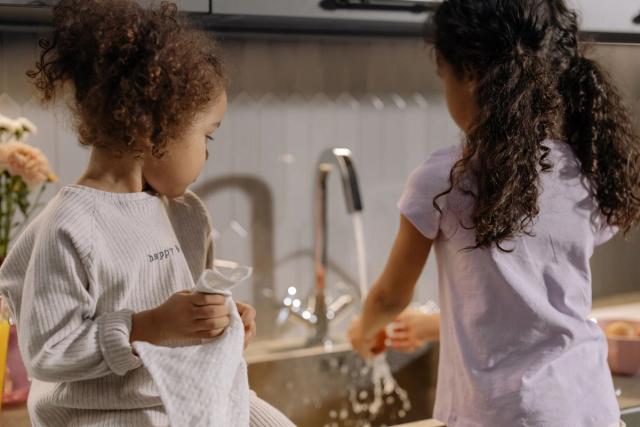
Your child knows how to empty the dishwasher. What they don't have yet is thinking of it at the moment it needs doing, with nobody in the room saying so. Responsibility is settled at the trigger, and the trigger is the last part you hand over. Most advice stops before it.
Three different things we call responsibility
Take one job. Emptying the dishwasher, say. There are three separate things a child can do with it, and we use the same word for all three.
- Your child can do the job with you standing next to them.
- Your child does the job alone when you ask.
- Your child thinks of it at the right moment with nobody asking.
Almost every chore chart, sticker system and family meeting is built to move a child from level 1 to level 2. Once the job gets done when asked, the advice runs out. So a parent who has been asking for months, and getting the job done every time, opens another article about chore charts and finds nothing in it, because they passed that point a while ago.
Level 2 is where the frustration sits, because you are still the one doing the remembering. Your child holds the skill and you hold the trigger.
Do this tonight. Pick one job in your house, name it out loud, and say which of the three levels it sits at. If you are not sure which jobs are reasonable to expect at all, Chore Chart by Age, 3 to 14 sets out what fits at each age. The level you land on decides which part of this article is for you.
Why they forget even though they know the job
Remembering to do something later has been studied in children directly, and the results are more specific than "kids are forgetful".
Kvavilashvili, Messer and Ebdon (2001, Developmental Psychology, 37(3), 418-430) ran three experiments with 264 children aged 4 to 7. The children named pictures on cards, and had to remember to hide the card whenever an animal appeared.
Some children missed all four animals. Questioned afterwards, every one of them could still say what they were supposed to do, so the instruction was intact and the triggering was what failed. The authors also found no relationship between how children did on the remember-to-act task and how they did on the plain memory task.
Two limits worth holding onto. The children were 4 to 7, and the task was short and took place in a laboratory. The authors note that age accounted for only a small part of the variation between children, so there is no age at which this switches on.
Kliegel, Mahy, Voigt, Henry, Rendell and Aberle (2013, Journal of Experimental Child Psychology, 116, 792-810) compared 6-7 year olds with 9-10 year olds in a driving game where they had to refuel when a cue appeared.
The older children did better, but only when the cue sat away from the center of attention. When the cue was directly in front of them, the six-year-olds did as well as the nine-year-olds. It was a video game and not a household job, so take it as a pointer about where to put the cue and nothing more.
What I would change tonight: stop re-explaining the job, because the instruction is not what is missing, and move the cue to where your child physically is at the moment the job is due. A magnet on the fridge does nothing while the fridge is in the kitchen and your child is upstairs.
Handing over the trigger, one job at a time
Here is the whole procedure. Setting it up takes about two minutes.
- Pick one job your child already does alone when asked. Not a new job.
- Attach it to a moment they can see going past, rather than to a clock time: the end of dinner, coming out of the shower, walking in from school.
- Say it once, and tell them you are going to stop reminding them about that one job.
- Let the misses happen without taking the job back.
- Wait three weeks before handing over a second job.
Step 2 matters because a clock time is a cue only for someone who checks clocks, which is a second job on top of the first. A moment your child moves through anyway asks nothing extra of them. If you write the job down somewhere, write the moment next to it, and Responsibility Chart: What to Write in the Boxes covers the wording.
Step 5 has evidence behind it. Redshaw, Vandersee, Bulley and Gilbert (2018, Child Development, 89(6), 2099-2108) gave 63 children aged 7 to 13 an easy and a hard version of a memory task. All of them predicted they would do worse on the hard version, but only the children over 11 actually set themselves more reminders when they expected to struggle.
That was 63 children, roughly 21 per age band, so treat 11 as a rough region rather than a line. Below it, putting the cue in the house is your job, because your child will not build one for themselves even when they know they need one. Above it, you can ask them to set the reminder, and asking a child to set a reminder is a different request from asking them to do a job.
What changes between 5 and 14
| Age | What they can carry on their own | What stays on you |
|---|---|---|
| 5-7 | The action, if the cue is in front of them at the right moment | Putting the cue there, and triggering it every time |
| 8-10 | The action and the cue, if the cue is visible from where they are standing | Checking the cue is still where it was, and not reminding |
| 11-14 | The action, and increasingly setting their own reminder | Staying quiet, and agreeing what happens when the job is skipped |
These three bands come from the three studies above and nothing else. Those studies used laboratory tasks and games rather than household jobs, and no child crosses from one row to the next on their birthday.
Mahy, Moses and Kliegel (2014, Developmental Review, 34, 305-326) review this area and describe the abilities involved as still developing through adolescence, so expect the rows to overlap for years. A teenager who forgets has not gone backwards.
For the youngest band the choice of job does most of the work, since a job that needs an adult standing there cannot be handed over at all. 10 Chores for 5 to 7 Year Olds That Actually Work lists jobs a child can finish alone.
When it's half done, or not done at all
The job is done, but badly. It counts as done. If you redo it the same evening, you have taken the job back, and tomorrow the remembering is yours again. When the result genuinely will not do, come back to it on a calmer day and show them once more, rather than correcting it in front of them.
It gets skipped one evening. Say nothing that evening. Work out instead what was happening at the moment of the cue: whether your child was in another room, whether a screen was on, and whether the moment you picked actually occurs every single evening.
It gets skipped three evenings running. Now the cue is wrong, or the moment you picked does not come round reliably. Change the moment. Do not change the child and do not add a penalty, because a punishment does not put the reminder back where it needs to be, and willingness is not what was missing.
One more thing you are allowed to do. During a heavy week, take the job back and say out loud that you are taking it back for a few days. Announcing it keeps the week from counting as a miss on your child's side.
What this doesn't fix
The benefit of household chores to a child is poorly established. The largest study I know of is White, DeBoer and Scharf (2019, Journal of Developmental & Behavioral Pediatrics, 40(3), 176-182), which followed close to 10,000 American children from kindergarten to third grade.
Children who rarely did chores at 5 had somewhat higher odds of landing in the bottom fifth on self-reported competency measures at 9, with odds ratios between 1.17 and 1.27. Those gaps are small, the study is correlational, and it does not show that a chore causes anything.
The Harvard study people quote, the one said to prove chores predict success in life, does not exist in that form. The paper behind the claim is Vaillant and Vaillant (1981, American Journal of Psychiatry, 138(11), 1433-1440), which followed 456 men from a poor Boston neighborhood born in the 1920s and 1930s and measured a "capacity to work in childhood" that has nothing to do with household chores.
Responsibility also does not travel from one area to another. A child who runs the dishwasher unprompted will not start opening their schoolbag because of it, since those are two separate cues that have to be installed separately. Homework has its own starting point, and Stop Homework Battles: Where to Start deals with it on its own terms.
What to remember
- While you are the one thinking about the job, the job is still yours, however reliably your child does it when asked.
- A child who forgets has not forgotten the instruction. In the Kvavilashvili study, every child who missed all four occasions could still state the rule afterwards. Change when the reminder arrives instead of explaining the job again.
- Attach the job to a moment your child sees going past, and put the cue where they physically are at that moment.
- Hand over one job at a time, and wait three weeks before the next one.
- A job done badly still counts as done. Redoing it the same evening hands the reminder back to you for tomorrow.
The easiest cue to move around is a printed sheet you put in the room where the job happens. Harmonia's chore chart generator is free and gives you the PDF to print.
Frequently asked questions
What does responsibility actually mean for a child?
It covers three separate abilities: doing a job with an adult next to them, doing it alone when asked, and thinking of it at the right moment with nobody asking. A child can be solid on the first two and have none of the third. When a parent says their child is not responsible, they usually mean the third one is missing.
At what age can a child think of a job on their own?
There is no age that switches this on. In the Kvavilashvili study of children aged 4 to 7, age accounted for only a small share of the differences between children. What changed results more than age was where the cue sat: in the Kliegel driving-game study, six-year-olds matched nine-year-olds when the cue was right in front of them.
How do you teach responsibility to a 10-year-old?
Take one job they already do when asked. Attach it to a moment they pass through every day, such as the end of dinner. Tell them once that you are going to stop reminding them about that job, then stop. At ten, keep placing the cue yourself: in the Redshaw study, children only started setting their own reminders after about eleven. Wait three weeks before adding a second job.
How do you teach responsibility to a 12-year-old?
Same procedure, with one change. Rather than placing the cue yourself, ask how they are going to remember, and let them set it. A phone alarm counts. In the Redshaw study, children over eleven were the ones who actually set themselves more reminders when they expected a task to be hard. Agree in advance what happens when the job is skipped, so nothing has to be decided in the moment.
Should you redo a job that was done badly?
Not that evening. Redoing it takes the job back, and the following day the remembering is yours again. Let the poor version stand, and if the result genuinely will not do, show them again on a calmer day. Correcting the method and reacting to a bad result are two different conversations, and mixing them tends to end the handover.
Does an app like Harmonia replace the parent's reminder?
It moves the reminder off you, which takes the friction out from between you and your child, since the notification arrives from a phone rather than from someone standing in the kitchen. It is still a reminder coming from outside. Your child thinking of the job with nothing prompting them is a further step, and no app performs it for them.