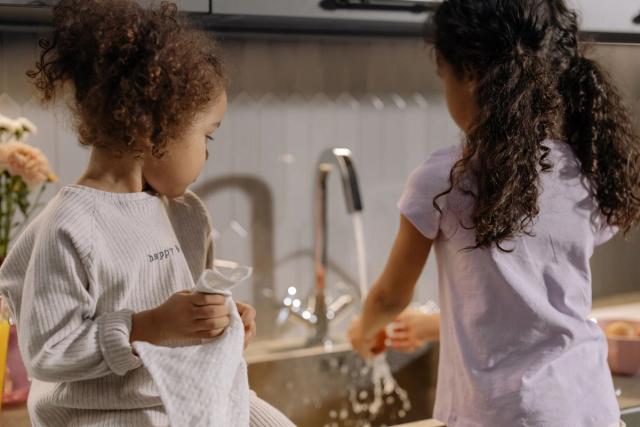
Why do chores create jealousy between siblings?
Chore-related jealousy often reflects a feeling that the family contribution, the effort required, or the recognition received is unfair. A child may believe a sibling has an easier job, gets more help, or avoids tasks that are less visible. Another child may be working hard, but mainly on responsibilities that happen at different times or in private.
Direct comparison can make this feeling stronger. Children notice who carries the laundry basket, who clears the table, and who is reminded first. They do not always notice the sibling who packs school items, resets a shared room after an activity, empties the dishwasher, or completes a task before anyone asks.
There may be a real difference in workload. There may also be a difference in perception caused by poor visibility or different working speeds. Both deserve attention. Telling a child that the situation is fair before understanding the complaint can sound dismissive, even when the parent has good reasons for the original arrangement.

Equality and equity: two ways to divide chores
Equality means giving children the same task or the same number of tasks. Equity means adjusting the contribution so that the expected effort is reasonably balanced. These approaches can lead to different assignments. A young child may sort socks or put away lightweight items, while an older child handles a more complex task that requires planning, strength, or sustained attention.
A fair arrangement considers more than the label on the chore. Look at its approximate duration, physical or mental difficulty, frequency, supervision required, and the child's current constraints. A teenager may have greater independence but also a demanding school schedule. A younger child may have more available time but need close guidance. Neither factor should be used automatically to excuse every responsibility or assign every difficult task to the oldest child.
Criteria for comparing the real effort behind different household chores.
| Criterion | What to compare |
|---|---|
| Duration | How long the task usually takes |
| Difficulty | Planning, strength, skill, or concentration required |
| Frequency | Daily, weekly, rotating, or occasional |
| Support | Reminders, supervision, or help needed |
| Constraints | School, activities, health, or available time |
A simple explanation can prevent a long argument: “Fair does not always mean identical. We are looking at what each person can manage and how much effort the whole responsibility requires.” Children may still disagree, but they now have a clear principle to refer to. For age-appropriate ideas, see this chore chart by age.
Make an inventory of each child's real workload
Before changing the system, list what each child actually does across a full week. Include obvious jobs, such as feeding a pet, clearing dishes, taking out rubbish, or cleaning a shared area. Add less visible contributions: putting away materials after an activity, emptying part of the dishwasher, preparing school items, folding personal clothes, or restoring order after using a common space.
A weekly view is more useful than a single-day comparison. Rotating tasks and occasional jobs can otherwise distort the discussion. One child may have a demanding responsibility on a particular day, while another carries a smaller daily task that adds up over the week.
Do not count only the number of boxes on a chart. One box might represent a quick, familiar job; another might involve several steps and repeated reminders. Write down the task, how often it happens, the approximate effort, and the level of independence expected. This turns a vague accusation into information the family can examine.
A weekly comparison that focuses on contribution rather than the number of assigned chores.
| Responsibility | What to record |
|---|---|
| Task | The specific job and its expected result |
| Frequency | When and how often it occurs |
| Effort | Time, difficulty, and physical or mental load |
| Independence | Whether reminders or supervision are needed |
| Review note | What worked or felt unbalanced |
Answer “That is not fair” without taking sides
Treat the complaint as useful information rather than proof that the child is right or wrong. Start with a calm invitation: “Tell me which part feels unfair.” Ask about the specific responsibility, how often it occurs, how long it takes, and what help is needed. This slows the argument down without promising an immediate change.
Then reformulate the concern using observable details: “You feel that emptying the dishwasher takes longer than clearing the table, and both jobs appear once on the chart.” This does not confirm the conclusion. It shows that the concern has been heard and gives the family something concrete to compare.
Avoid statements about character, such as “Your sister is more responsible” or “Your brother never helps.” Those comparisons move the conflict away from the system and toward identity. They can also make cooperation harder because a child starts defending their reputation instead of discussing the task.
A useful response may be: “We will not decide this by comparing people. We will compare the responsibilities over the week, then decide whether one task needs to be adjusted.” For further guidance on keeping instructions calm and practical, read How to Get Kids to Do Chores Without Yelling.
Build a clearer and more flexible chore system
Write responsibilities where everyone can see them. Use precise wording: “Clear your place, put dishes in the dishwasher, and wipe the table” is easier to follow than “Help after dinner.” Clarify whether the task includes putting materials away, checking the result, or asking for help when a child cannot complete it safely.
A visible chart can also reduce memory-based arguments. Children do not have to rely on who remembers an instruction or who was reminded most recently. A responsibility chart with clear boxes can show the task, the person responsible, and when it is considered complete.
Consider rotating tasks that are especially popular, unpleasant, or seen as more important. Rotation can prevent one child from being permanently assigned the job everyone notices, while another always receives background work. It also helps children practise different skills. The rotation does not need to happen every day; choose a rhythm that is easy for the family to remember.
Set a review point in advance. A new arrangement may need attention after a birthday, a change in school schedule, a new activity, or a clear increase in independence. Put the review on the family calendar rather than reopening the entire system whenever an argument occurs. A weekly chore schedule can help make rotations and review dates part of the routine.

When siblings keep arguing after the system changes
If the same dispute continues after the workload has been reviewed, the chore may no longer be the whole issue. The argument may also reflect a need for recognition, attention, control, or reassurance that each child matters. This does not mean the original complaint was false. It means the family may need to address the practical task and the emotional concern separately.
Keep two conversations distinct. The first concerns the system: who does what, how often, and with what support. The second concerns a particular moment: whether a task was completed, whether someone took over another person's job, or whether a reminder was delivered respectfully.
It is reasonable to keep a temporary rule while waiting for the scheduled review. You might say, “This is the arrangement for this week. Write down what seems unbalanced, and we will discuss it on Sunday.” The child receives a clear next step without gaining control of the household plan through repeated objections.
Recognition also matters. Notice completion, improvement, and cooperation without ranking siblings. “You remembered to reset the room before moving on” is more useful than “You did better than your brother.” The aim is a comprehensible family contribution, not a competition for parental approval.
Key takeaways: the check-in to use tonight
Set aside a short, calm moment and ask each child to identify the responsibility that feels least fair and explain why. Compare the effort required across the week, including hidden tasks, reminders, and rotating jobs. Choose one adjustment that can be tested without redesigning the whole household system. Write down when you will review it. If daily reminders are becoming the main source of conflict, clarify ownership and gradually hand over more of the reminder process; Teaching Kids Responsibility: Hand Over the Reminder explores that transition.
- Listen for the specific task behind “That is not fair.”
- Compare effort, duration, frequency, and supervision rather than counting boxes.
- Make less visible responsibilities explicit on a shared chart.
- Use rotation for tasks that are especially unpopular or highly valued.
- Test one change, then review it on a planned date.
Frequently asked questions
Why do my children argue about household chores?
They may perceive a difference in effort, frequency, support, or recognition. The workload may also be genuinely uneven, or some responsibilities may be less visible than others. Ask each child to identify the specific task that feels unfair before deciding how to change the system.
Should every child have exactly the same chores to prevent jealousy?
No. Identical chores do not always require identical effort because children differ in age, ability, speed, independence, and available time. A fair system can assign different responsibilities while aiming for a reasonably balanced contribution across the week.
How can I tell whether the chore division is genuinely unfair?
Review the full week rather than one day. Compare each responsibility's duration, difficulty, frequency, supervision, and constraints. Include less visible work such as resetting shared spaces and preparing personal items. The number of tasks alone is not enough.
What should I say when a child claims that their sibling never does anything?
Ask what specific task makes them feel that way, then compare observable details rather than personalities. You can say, “Let us look at what each person is responsible for this week.” Avoid confirming or rejecting the accusation before checking the complete list.
Should siblings rotate chores?
Rotation can be helpful for tasks that are unpopular, highly visible, or seen as more desirable. It gives children experience with different responsibilities and reduces the risk that one child is permanently associated with a particular job. Choose a simple rotation rhythm and publish it clearly.
How should chores be divided between a five-year-old and a teenager?
Give the younger child short, concrete tasks that match their abilities and provide the necessary supervision. The teenager can take on responsibilities requiring more planning, strength, or independence, while still having a realistic schedule. Compare expected effort rather than assigning the same task or number of tasks to both children.